

Montgomery Community College is proud to unveil its newly-expanded Nursing Laboratory, a state-of-the-art learning environment designed to prepare the next generation of nurses through hands-on training and advanced simulation experiences. Located in Capel Hall, the 1,800-square-foot laboratory serves students enrolled in both the Practical Nursing and Associate Degree Nursing programs.
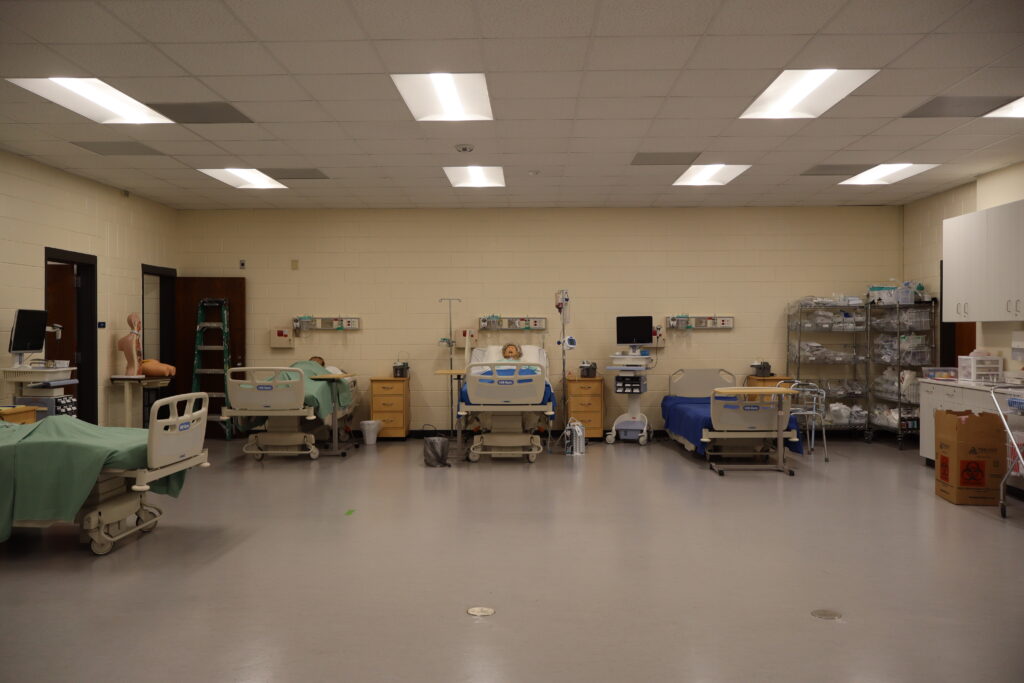
Designed to replicate a modern hospital setting, the laboratory provides students with opportunities to develop clinical skills in a realistic healthcare environment before entering patient-care settings. The space features seven patient care stations, including a neonatal bassinet, each equipped with a manikin representing patients across the lifespan. The collection includes an elderly man, elderly woman, adult woman, pregnant woman, teenage girl, child and newborn infant.
Several of the high-fidelity manikins are computer-controlled and can be programmed to simulate realistic patient conditions, including changes in heart rate, blood pressure, respiratory status and other physiological responses. Faculty can create a variety of clinical scenarios, allowing students to practice assessment, decision-making and patient care interventions in a safe and controlled environment.
“Students spend a significant portion of their education in clinical settings, learning alongside experienced healthcare professionals, which is an essential component of nursing education,” said Melody Wright, MCC’s Executive Director of Allied Health. “This new nursing laboratory allows students to build confidence and clinical competence in a realistic healthcare environment before entering patient-care settings. It extends learning opportunities beyond the clinical site and strengthens skill development here on the MCC campus.”
In addition to full-body manikins, the laboratory includes numerous task trainers, specialized training models that allow students to repeatedly practice individual nursing skills. Procedures such as inserting feeding tubes, catheterization, airway management, medication administration, and other essential nursing techniques can be performed repeatedly until students develop proficiency and confidence.
The laboratory is equipped with many of the same tools and resources found in today’s healthcare facilities. Students train using adjustable hospital beds, patient monitoring equipment, intravenous therapy supplies, emergency response equipment, suction devices, eyewash stations, medication administration systems, and inventory-controlled supply areas. A simulated narcotics storage system further enhances students’ understanding of medication safety and regulatory compliance.
A dedicated observation room allows nursing faculty to monitor student performance and guide simulation experiences without disrupting the learning environment. From this space, instructors can control patient scenarios, introduce emergencies, and evaluate students’ clinical judgment, communication, teamwork and problem-solving abilities in real time.
“Simulation-based training allows students to practice procedures repeatedly while developing clinical judgment, communication skills, and confidence,” said Melody Wright. “The laboratory provides a safe environment where students can learn from mistakes, refine their skills and prepare for real-world patient care.”
The expanded laboratory reflects Montgomery Community College’s commitment to preparing highly skilled nurses to meet the healthcare needs of Montgomery County and surrounding communities. By combining advanced simulation technology with hands-on instruction, MCC continues to provide students with the knowledge, experience, and confidence needed to deliver safe, high-quality patient care upon graduation.