

Meet Rebekah Bunting, Chair of MCC’s Science Department and cherished Biology instructor. Rebekah is from Asheboro and lives there now. Her undergraduate work (Zoology and English) and masters-level work (Zoology) were all completed at North Carolina State University in Raleigh.
Rebekah was an able student from early on, becoming interested in science in second grade. “As a child I was extremely intrigued by geology, which morphed into archaeology, which became paleontology and eventually zoology,” explains Rebekah. “Science was my first love, however I was an avid reader and eventually a strong writer, thus the English aspect.”
During graduate school, Rebekah had the opportunity to serve as a Teaching Assistant for her major professor, an appointment which involves delivering class lectures and grading assignments. It was during this experience that she realized how much she loved teaching. She took adjunct instructor positions teaching animal diversity and comparative anatomy, and eventually found Montgomery Community College through similar opportunities teaching anatomy and biology.
In January of this year, Rebekah was awarded the Excellence in Teaching Award – for the third time. “It is special to me,” says Rebekah. “It signifies I am making an impact in the classroom and generating student awareness of science, which is what is really important.”
Rebekah has taught at MCC for 19 years, and during that time she has outfitted a very impressive biology lab. “I cannot remember a time when I was denied materials or equipment for my students. MCC has given us everything we need to learn and succeed in the classroom.”
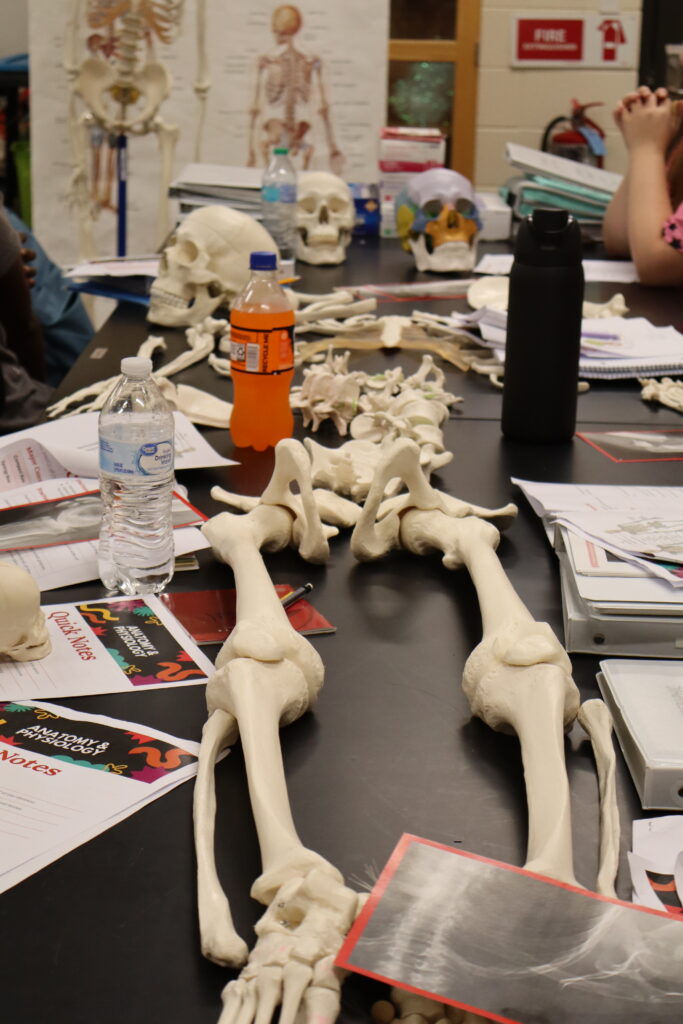
During the writing of this story, Rebekah’s BIO165 class was analyzing human bones. In addition to skeletons covering the tables, students were examining x-rays on a screen, later trying to determine the situation affecting the owner of a skull with three round holes present in the parietal bone. (These three holes were from trepanation, a surgical procedure dating back 1,000 years!)
The present generation of college students has grown up watching a lot of science programming, making the discipline seem interesting and important. “I would be remiss if I didn’t tip my hat to True Crime and Forensic Files television genres,” explains Rebekah. “Students today come to their first biology class knowing more about human bodies than was the case for my generation.”
Rebekah’s department is growing in popularity, with the addition of a second Biology teacher, Ms. Hailey Bullard. “There is demand for science here, and I am pleased we can offer multiple sections. Many of our students are moving on to universities, and choose to complete their science electives here in a small class setting with individual attention from Ms. Bullard and me.”
One way Rebekah keeps students engaged is to tie each lesson plan to historic or current events. Biology as a science is changing every day, and while it may take textbooks time to catch up, Rebekah is an avid reader of scientific journals, and is committed to presenting new findings in the context of students’ daily lives. “A day doesn’t go by without a student telling me about how one of our classroom topics intersects with something they saw, or are experiencing personally,” says Rebekah. “I don’t have to get them excited about science, because they are recognizing and appreciating it each day.”